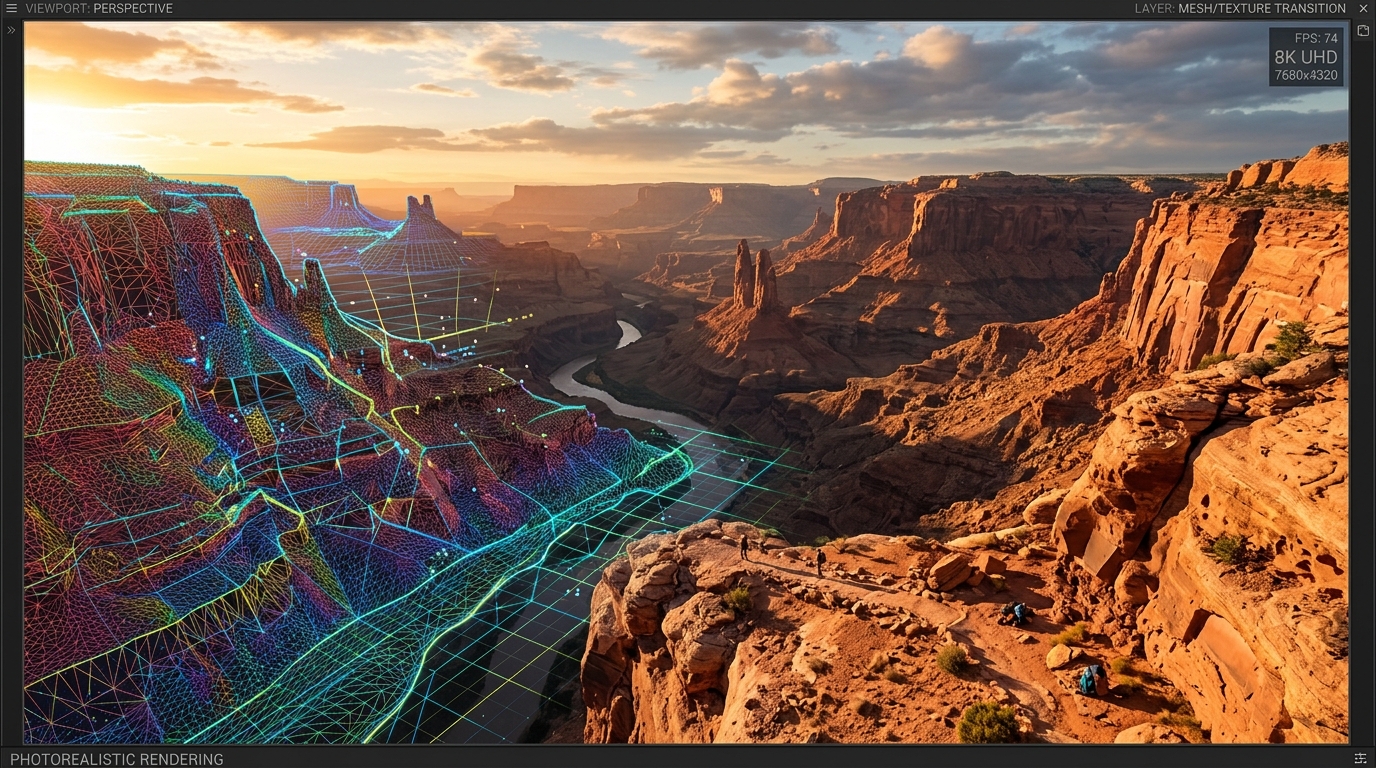
For three decades, video game rendering was an elaborate sequence of compromises: hand-crafted Level of Detail (LOD) cascades, baked shadowmaps, and polygon budgets. With Unreal Engine 5.6, Epic Games has completed the transition to film-grade computational graphics, rendering billions of micropolygons in real-time with zero discernible geometric pop-in.
1. Nanite 2.0: The Death of Polygon Budgets
In legacy rendering pipelines, a 3D artist would sculpt a 20-million polygon character in ZBrush, only to bake normal maps onto a heavily simplified 50,000 polygon low-poly mesh. Nanite fundamentally inverts this workflow:
- Continuous Level of Detail: Nanite groups triangles into clusters of approximately 128 polygons. At runtime, the GPU evaluates screen-space pixel area and dynamically swaps clusters every frame, guaranteeing that triangles are no larger than a single screen pixel.
- Programmable Rasterizer: When triangles drop below pixel size, traditional hardware rasterizers bottleneck. Nanite switches to a high-speed software compute rasterizer, maintaining blistering frame rates even in scenes with 500,000,000 active geometric triangles.
- Nanite Skeletal Meshes & Foliage (UE 5.6): The latest 5.6 release natively supports deformable rigged characters and animated wind-blown foliage—previously the two major limitations of Nanite’s rigid-mesh limitation.
2. Lumen: Real-Time Dynamic Global Illumination & Radiosity
Gone are the days when level designers had to wait 12 hours for lightmaps to bake into static textures. Lumen calculates infinite-bounce diffuse interreflection and specular reflections in real-time:
| Feature | Software Ray Tracing | Hardware Ray Tracing (UE 5.6) |
|---|---|---|
| Scene Representation | Mesh Distance Fields & Voxel Grids | Full BVH Traversal (Dedicated RT Cores) |
| Reflection Precision | Approximated card reflections | Mirror-sharp, curved surface reflections |
| Skinned Character Lighting | Low-frequency approximate bounce | Exact secondary color bleeding & self-shadowing |
| Target Hardware | PS5 / Xbox Series X / Mid-Tier PC | RTX 4080 / 5080 / 5090 Tier |
3. Substrate: Layered Physical Materials for Cinema Realism
Prior versions of Unreal utilized a monolithic shading model with fixed metallic, roughness, and specular parameters. Substrate completely replaces the material pipeline with a modular, physically accurate system:
- Multi-Layer Coating: Render car paint featuring a clear-coat lacquer over a metallic flake base layer with physically accurate refraction and absorption indices.
- Subsurface Scattering for Digital Humans: Multi-layer epidermal and dermal light scattering simulating authentic human capillaries and skin translucency.
- Anisotropic Fibers: Authentic carbon fiber weaves and brushed aluminum surfaces with accurate specular stretch.
4. Virtual Shadow Maps (VSM) & Nanite Tessellation
Traditional shadow mapping suffers from resolution limits and memory bloat. Virtual Shadow Maps render shadows at a virtual resolution of 16k x 16k using clipmaps, streaming only the high-resolution pages visible on screen. Combined with Nanite Tessellation, cobblestone roads and brick masonry can physically deform outward with millimeters of physical displacement without requiring manual sculpting.
5. The Performance Challenge: 60 FPS on Modern Consoles
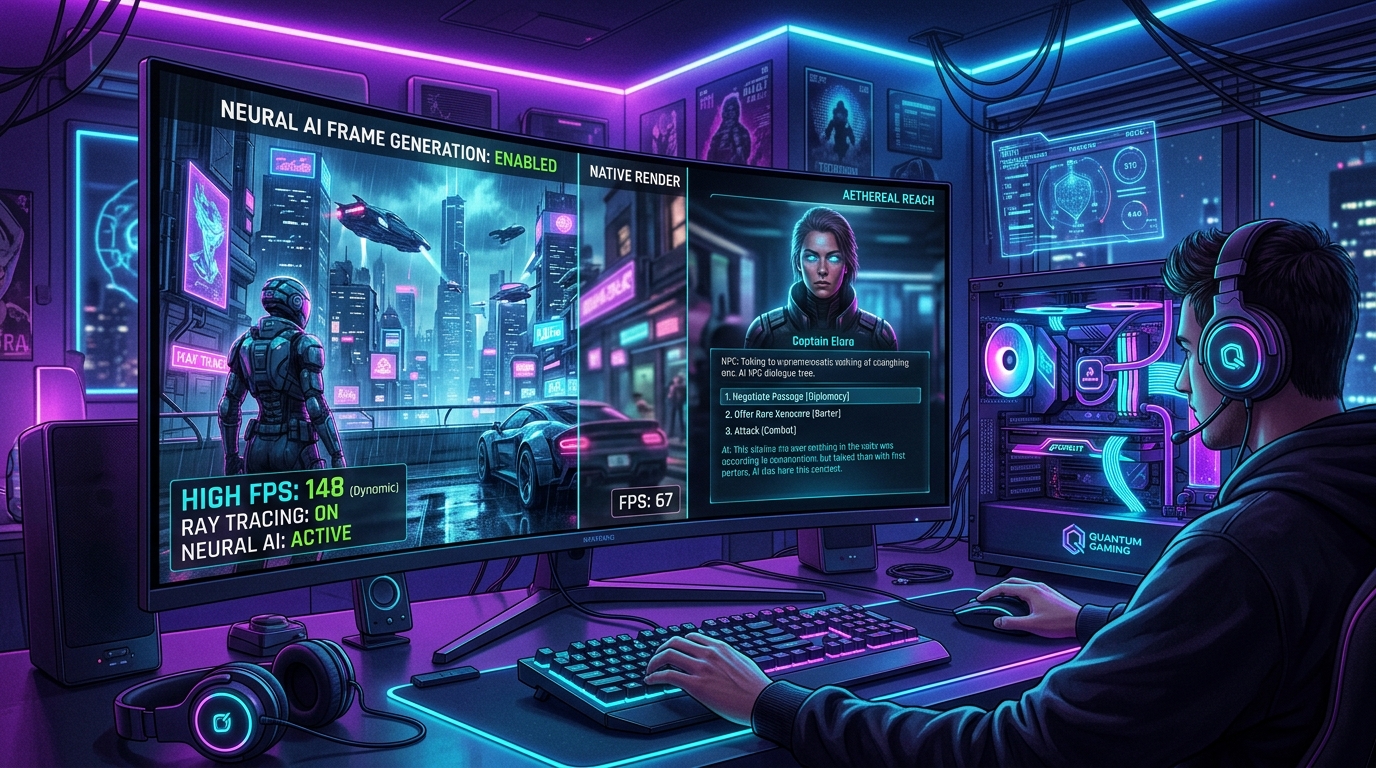
While visual fidelity has attained cinema parity, running full-featured UE 5.6 titles on current-generation consoles (PS5 and Xbox Series X) remains challenging. Most commercial studios deploy Temporal Super Resolution (TSR) with internal render resolutions of 1080p–1440p upscaled to 4K. As PC GPUs adopt dedicated neural reconstruction like DLSS 4, the industry is racing toward 60–120 FPS baseline standards.
🎮 Games Showcasing the Technology:
- The Witcher 4 (Polaris): Built exclusively on CD Projekt Red’s customized UE5 engine branch.
- Grand Theft Auto VI (RAGE 9 Engine): Utilizing similar virtualized geometry principles for unprecedented Vice City urban density.
- Senua’s Saga: Hellblade II: Demonstrating Substrate human skin fidelity and hyper-realistic micro-lighting.