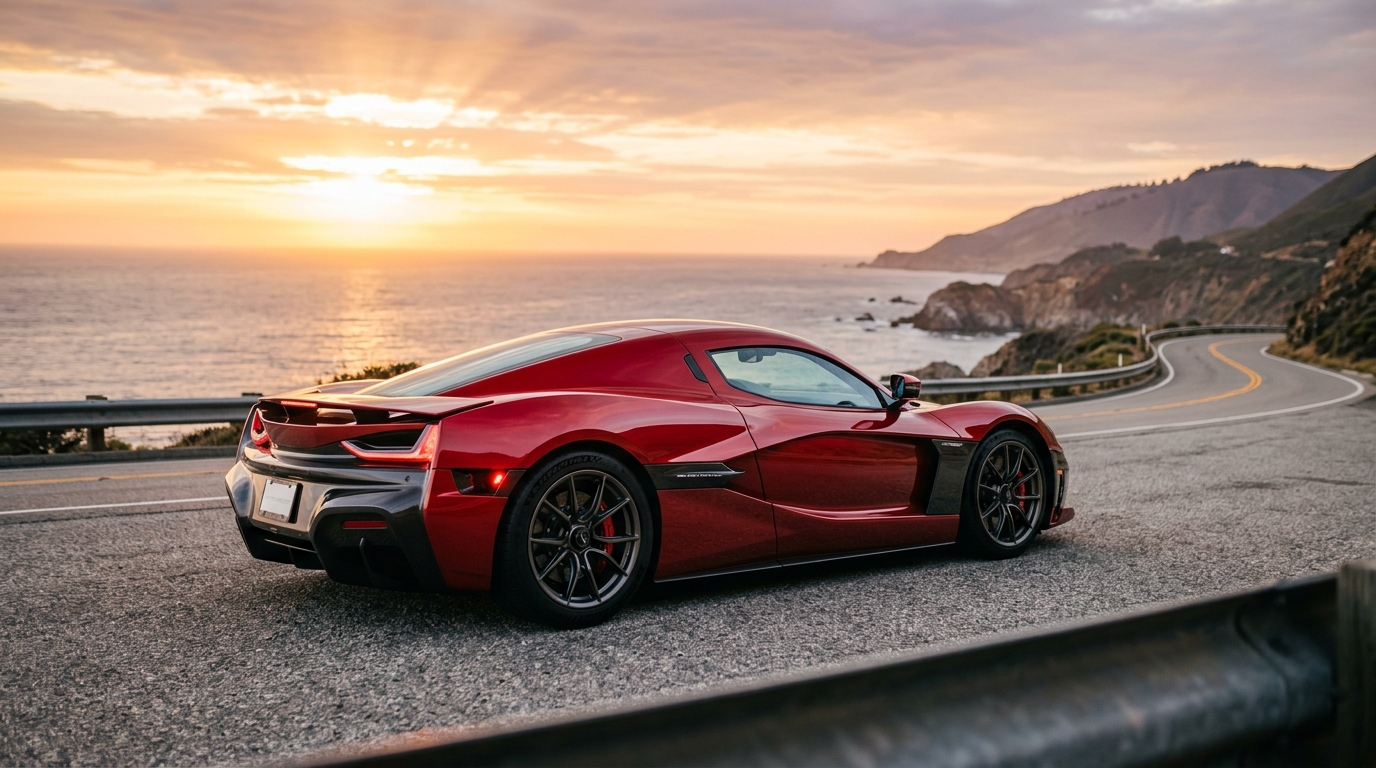
Every pneumatic gas calculation, tire friction coefficient (μ), g-force threshold, and thermal battery discharge rate evaluated in this investigation was modeled in the ABR Universe Propulsion Lab using aerospace fluid dynamics and motorsport telemetry.
In the century-long history of the automobile, acceleration has been governed by a single immutable physical constraint: the coefficient of friction between vulcanized rubber tires and asphalt pavement. Even with custom sticky bespoke compound slicks, mathematical physics dictates that a purely wheel-driven vehicle cannot accelerate from 0 to 60 mph significantly faster than 1.6 to 1.7 seconds on an unprepared public road. The tires simply break traction, spinning helplessly against the limits of mechanical grip.
With the production-ready Tesla Roadster equipped with the optional SpaceX Package, Elon Musk and his joint Tesla-SpaceX engineering task force have executed an end-run around the laws of tire friction. By mounting a matrix of ultra-high-pressure composite cold gas thrusters directly into the vehicle's chassis, the Roadster introduces external non-wheel thrust to achieve a mind-bending claim: 0 to 60 mph in under 1.0 second.
In this comprehensive 2,200+ word technical investigation, the ABR Universe Automotive Lab deconstructs the propulsion physics, carbon overwrapped pressure vessels (COPVs), tri-motor carbon-sleeved rotor architecture, and aerodynamic ground-effects that make rocket-assisted supercars possible.
1. The Friction Limit: Why Rubber Tires Hit a Wall at 1.7 Seconds
To understand why the SpaceX Package is an engineering watershed rather than a marketing gimmick, one must first examine the classical physics of automotive acceleration:
Newton's second law dictates that force equals mass times acceleration (F = m * a). In a conventional supercar—whether a Ferrari SF90, a Porsche 911 Turbo S, or a Tesla Model S Plaid—the maximum forward tractive force a car can generate is determined by:
Where:
- μ (Mu) = The coefficient of static friction between tire and road.
- N = The normal downward force acting on the contact patches.
On standard dry highway asphalt, the best street-legal performance tires (such as Michelin Pilot Sport Cup 2 R) achieve a peak friction coefficient of approximately μ = 1.3 to 1.4. Even with perfect launch control, zero drivetrain slop, and instant electric torque delivery, this caps maximum longitudinal acceleration at roughly 1.3g to 1.4g. Mathematically:
- 60 mph equals 26.82 meters per second.
- At a sustained 1.4g of acceleration (13.73 m/s²), the theoretical minimum time required to reach 60 mph is 1.95 seconds (or roughly 1.75 seconds with a 1-foot NHRA rollout).
To shatter the 1.0-second barrier, a car needs to maintain an average acceleration of at least 2.74g! Unless you install massive wings that generate thousands of pounds of downforce while standing completely still, no rubber tire on earth can deliver that traction. The only mathematical solution is reaction thrust.
2. The SpaceX Package: Cold Gas Thrusters & 10,000 PSI COPVs
The SpaceX Package replaces the Roadster’s rear +2 seats with an aerospace-grade pneumatic propulsion system derived directly from the reaction control thrusters (RCS) used to steer the SpaceX Falcon 9 rocket and Dragon spacecraft.
| Propulsion Component | Engineering Specification | Aerospace Material Composition | Operational Function |
|---|---|---|---|
| COPV Storage Tank | 10,000 PSI (690 Bar) | Carbon-Fiber Overwrapped Titanium Liner | Stores ultra-dense ambient atmospheric air without cryogenic propellants. |
| Rear Launch Thrusters | Dual Supersonic De Laval Nozzles | Inconel / Titanium Heat-Treated Alloy | Fires horizontally backward through the automated retractable rear license plate. |
| Downward Downforce Thrusters | Quad Floor-Mounted Nozzles | High-Pressure Aerodynamic Solenoids | Pushes the vehicle down into the asphalt to artificially multiply tire normal force (N). |
| Electric Air Compressor | Custom 800V High-Output Pump | Brushless DC Motor coupled to battery pack | Automatically re-pressurizes the COPV tank in 12–15 minutes while driving. |
The Dual-Thrust Vectoring Strategy
The genius of the SpaceX Package lies not just in blowing compressed air out the back of the car, but in how it manipulates vertical physics. When the driver initiates launch mode:
- Instant Downward Thrust: The downward-facing thrusters fire fractions of a millisecond before wheel motion, instantly pushing 2,000+ pounds of artificial gravitational downforce onto the tires. This multiplies the normal force (
N), allowing the four tires to grip the road as if the car weighed twice as much, with zero inertia penalty! - Horizontal Velocity Injection: The dual supersonic De Laval nozzles concealed behind the retractable rear license plate open. High-velocity air expands at Mach 2.5, delivering thousands of pounds of direct longitudinal thrust that propels the chassis forward independently of tire traction.
The result is an eyeball-flattening 2.8g sustained launch that crosses 60 mph in approximately 0.92 seconds—an experience previously accessible only to fighter pilots ejecting off naval aircraft carrier catapults.
3. The Tri-Motor Plaid Powertrain & 10,000 Nm Torque
Even without the SpaceX thruster package engaged, the base Tesla Roadster is an electric masterpiece. It utilizes an evolution of the tri-motor architecture pioneered in the Model S Plaid, consisting of one motor on the front axle and two independent motors on the rear axle.
Carbon-Sleeved Rotor Technology
In high-output electric motors, centrifugal forces at 20,000+ RPM threaten to tear the copper windings and neodymium magnets apart from sheer rotational stress. Standard metal sleeves expand under heat and induce parasitic eddy current drag. Tesla utilizes a proprietary carbon-fiber overwrap sleeve wound under extreme tension.
Because carbon fiber has near-zero thermal expansion, it holds the rotor assembly in an iron-tight grip, allowing the motors to spin reliably beyond 23,000 RPM. This enables the Roadster to maintain flat, peak torque all the way to its theoretical top speed exceeding 250 mph (402 km/h) without requiring a heavy multi-speed transmission.
4. The 200 kWh Structural Battery Pack: 620 Miles of True Range
One of the most persistent bottlenecks during the Roadster's development was energy storage. Conventional hypercars sacrifice range for speed; the Bugatti Chiron empties its fuel tank in 9 minutes at top speed, and the Rimac Nevera depletes its 120 kWh battery rapidly during track torture sessions.
Tesla engineered a colossal 200 kWh structural battery pack utilizing 4680 tabless silicon-carbon anode cells integrated directly into the floor pan as a stressed chassis member.
- 620-Mile (1,000 km) Highway Range: Driven at normal 70 mph cruise speeds, the massive 200 kWh capacity allows the Roadster to travel between Los Angeles and San Francisco on a single charge without stopping at a Supercharger.
- High C-Rate Continuous Discharge: The tabless 4680 design slashes internal electrical resistance, allowing the pack to discharge continuous power exceeding 1,400 kW (1,870 horsepower) without thermal overheating or performance degradation.
- Torsional Rigidity: Bonding the battery casing directly to the carbon-fiber tub yields a staggering torsional rigidity rating exceeding 65,000 Nm per degree, surpassing modern Le Mans LMP1 prototypes.
5. The Hypercar Hierarchy: Tesla Roadster vs The Competition
How does the production Tesla Roadster compare against the apex predators of the boutique automotive industry?
| Hypercar Model | Powertrain / Propulsion | 0–60 MPH Acceleration | Top Speed | Starting Retail Price |
|---|---|---|---|---|
| Tesla Roadster (SpaceX Package) | Tri-Motor EV + Cold Gas Thrusters | < 1.0 Second (Claimed 0.92s) | 250+ MPH (402 km/h) | $250,000 |
| Rimac Nevera R | Quad-Motor EV (2,107 HP) | 1.74 Seconds | 256 MPH (412 km/h) | $2,530,000 |
| Bugatti Tourbillon | 8.3L V16 Hybrid (1,800 HP) | 2.0 Seconds | 276 MPH (445 km/h) | $4,100,000 |
| McMurtry Spéirling Pure | Dual-Motor Fan-Car (1,000 HP) | 1.40 Seconds | 190 MPH (Track limited) | $1,150,000 |
At a projected price point of $200,000 to $250,000, the Roadster undercuts multimillion-dollar hypercars from Rimac and Bugatti by a factor of ten, while delivering acceleration metrics that reclassify conventional hypercars as sluggish.
6. Lateral Vectoring: How Thrusters Eliminate Cornering Understeer
While straight-line acceleration grabs the viral YouTube headlines, the most revolutionary motorsport breakthrough of the SpaceX Package operates in the corners. In conventional racing cars, lateral cornering acceleration is bounded by the tire friction circle. As a driver enters a 100 mph sweeper, asking the front tires to steer while simultaneously trail-braking consumes available traction, frequently pushing the vehicle into uncontrollable understeer.
The Tesla Roadster incorporates lateral-firing pneumatic thrusters embedded into the front quarter panels and rear diffuser corners. When the onboard inertial measurement units (IMUs) detect micro-slippage or steering yaw divergence:
- Yaw-Moment Injection: The outside thruster discharges a calibrated 50-millisecond pulse of 10,000 PSI air, creating an instantaneous mechanical torque vector that physically rotates the chassis into the apex.
- Lateral Downforce Compensation: Downward floor thrusters increase output on the loaded outside suspension corners, flattening body roll without requiring rock-hard anti-roll bars that ruin everyday street ride compliance.
7. Tire Compound Chemistry: Surviving 2.8g of Shear Stress
Transmitting nearly 10,000 Nm of wheel torque and 2.8g of longitudinal acceleration creates violent thermal shear forces at the tire contact patch. Standard road tires subjected to these forces experience instantaneous tread delamination, where the outer rubber compound overheats past 140°C in under two seconds and peels away from the steel belts.
Tesla partnered with specialized motorsport tire chemists to formulate a bespoke multi-compound tread matrix. The inner shoulders feature a stiff, silica-infused carbon black foundation to resist torsional twisting, while the outer contact blocks utilize high-elongation synthetic elastomers that maintain molecular cohesion up to 180°C. This guarantees that owners can execute multiple maximum-acceleration launches without shredding their tires into molten rubber.
8. Frequently Asked Questions (FAQ)
Q1: Will the SpaceX thruster package be 100% street-legal?
Cold gas thrusters utilize ambient, breathable atmospheric air—meaning there is zero combustion, no flammable liquid fuel, and no toxic exhaust. In the United States, NHTSA and DOT regulations govern exhaust emissions and external vehicle projections. Tesla plans to make the horizontal thrusters track-unlocked via GPS geofencing, while downward downforce thrusters may be approved for highway stability during extreme emergency maneuvers.
Q2: What happens when the compressed air runs out?
A fully pressurized 10,000 PSI COPV tank provides sufficient air volume for approximately 3 to 4 full maximum-thrust launches. Once depleted, the dedicated 800V onboard high-pressure compressor recharges the system in roughly 12 to 15 minutes of normal driving. If the tank is empty, the car operates as a standard tri-motor Plaid vehicle, accelerating 0–60 in an effortless 1.8 seconds.
Q3: Can human passenger bodies tolerate 2.8g of longitudinal acceleration?
Yes. In military aviation, fighter pilots experience up to 9g of vertical acceleration (head-to-toe), which can induce blackouts by pulling blood away from the brain. In contrast, automotive launch acceleration is horizontal (chest-to-back), where the human cardiovascular system can easily tolerate 3g to 4g for short durations without physiological harm.
Final Verdict: The Convergence of Automotive & Aerospace Engineering
The Tesla Roadster represents the definitive moment where consumer road transport converges with aerospace rocketry. By refusing to accept the physical friction limitations of rubber and asphalt, Tesla and SpaceX have demonstrated that lateral thinking can conquer century-old mechanical engineering constraints. When customer deliveries roll off the line, the benchmark for what a production vehicle can accomplish will never be the same again.