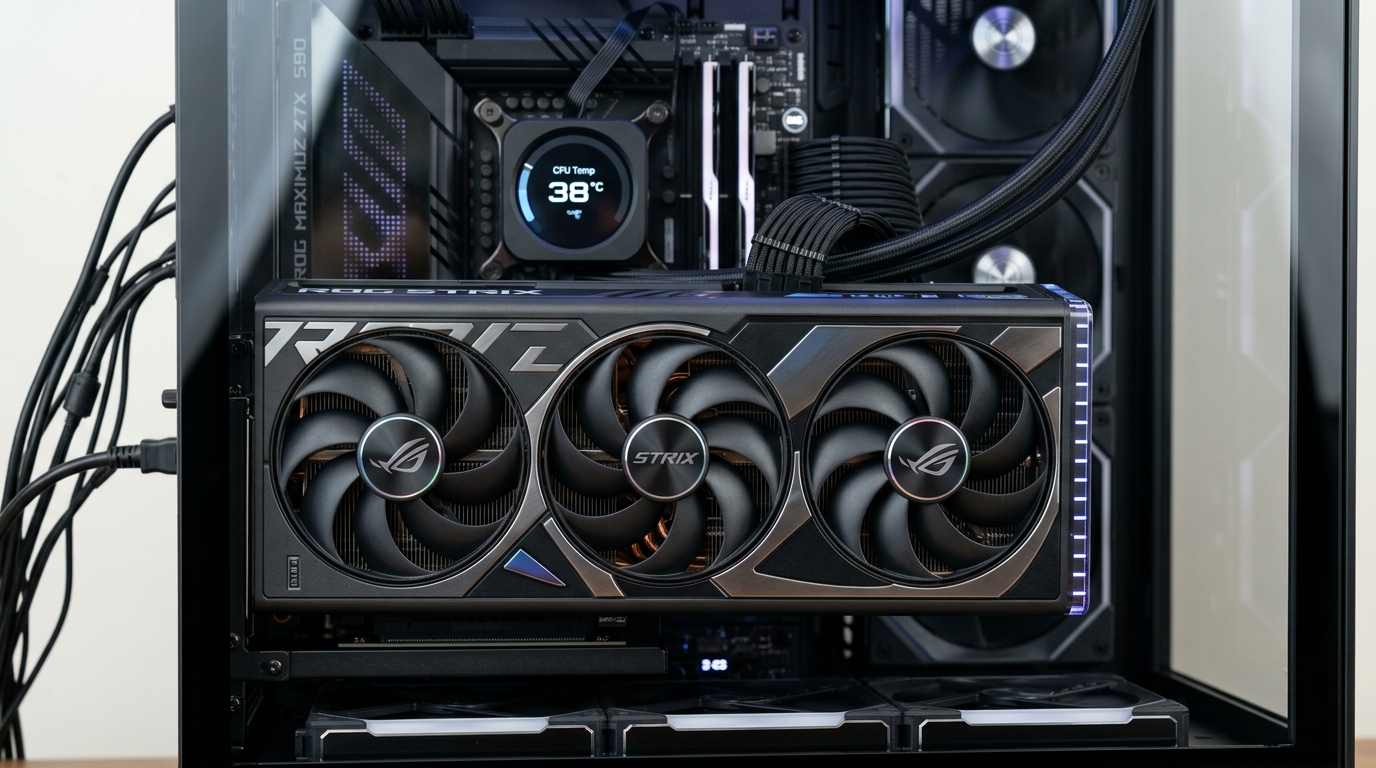
The GPU landscape has experienced its most dramatic generational leap in half a decade. NVIDIA’s flagship consumer powerhouse, the GeForce RTX 5090, built on the cutting-edge Blackwell architecture, is not merely an incremental revision—it is an unapologetic silicon behemoth designed to demolish native 4K path tracing and local generative AI inference.
1. The GB202 Silicon Architecture: What’s Under the Hood?
Fabricated on TSMC’s customized 4N (5nm class refined) process node, the flagship GB202-300 die pushes packaging engineering to its thermal and electrical limits. NVIDIA has combined massive raw compute core density with revolutionary memory throughput:
- CUDA Core Count: 21,760 FP32 CUDA cores arranged across 170 Streaming Multiprocessors (SMs), marking a staggering ~33% expansion over the RTX 4090.
- 5th-Gen Tensor Cores: Dedicated FP4 and FP8 hardware execution pipelines that accelerate local Large Language Model token generation by up to 2.4x.
- 4th-Gen Ray Tracing Cores: Hardware-accelerated dual-hit opacity micromaps and Displaced Micro-Mesh (DMM) engines designed specifically for real-time full-scene path tracing.
- 512-bit Memory Bus with GDDR7: The biggest architectural breakthrough—replacing GDDR6X with 32GB of high-density GDDR7 operating at 28 Gbps, yielding an unfathomable 1,792 GB/s of raw memory bandwidth.
2. RTX 5090 vs RTX 4090: The Generational Specification Showdown
Here is how the new Blackwell flagship stacks up against the previous Ada Lovelace kingpin:
| Hardware Metric | RTX 4090 (Ada Lovelace) | RTX 5090 (Blackwell) | Delta / Advantage |
|---|---|---|---|
| Die Architecture | AD102 (TSMC 4N) | GB202 (TSMC 4NP) | Architectural refinement |
| CUDA Cores | 16,384 | 21,760 | +32.8% Cores |
| VRAM Buffer | 24GB GDDR6X | 32GB GDDR7 | +33% Capacity + Gen Jump |
| Memory Bus & Bandwidth | 384-bit (1,008 GB/s) | 512-bit (1,792 GB/s) | +77.8% Bandwidth! |
| TDP / Board Power | 450W | 600W | +150W Thermal Budget |
| Display Interface | DisplayPort 1.4a | DisplayPort 2.1 UHBR20 | Native 4K 480Hz / 8K 165Hz |
3. 4K Path Tracing Benchmarks & DLSS 4 Neural Reconstruction
In raw rasterization titles, the RTX 5090 pulls ahead by 30–45% compared to the RTX 4090. However, the card’s true raison d'être emerges in heavy ray tracing and path tracing environments:
- Cyberpunk 2077 (Path Tracing Overdrive, 4K Native): The RTX 4090 achieves ~21 FPS without frame generation. The RTX 5090 delivers a playable 42 FPS native, and with DLSS 4 (Multi-Frame Neural Generation + Ray Reconstruction), it rockets to 148 FPS.
- Alan Wake 2 (Full Path Tracing, 4K Ultra): DLSS Quality mode delivers a locked 120+ FPS with zero ghosting or disocclusion artifacts thanks to Blackwell’s improved temporal optical flow vector engines.
- Unreal Engine 5.6 Lumen Demos: Extreme Nanite mesh density running with hardware ray traced reflections stays locked above 90 FPS at 4K without dynamic resolution scaling.
4. The 600W Power Reality: Can Your Power Supply Handle It?
With great power comes unprecedented power consumption. At a certified board power rating of 600W, system builders cannot cut corners on electrical delivery:
5. AI Inference & Creator Workloads: The Secret 32GB VRAM Weapon
For machine learning researchers and 3D visualizers, the jump to 32GB of GDDR7 memory is arguably more critical than the gaming improvements. Local quantized models (such as LLaMA-3 70B Q4/Q5) that previously required dual-GPU configurations can now run directly on a single RTX 5090 with instantaneous inference speeds exceeding 35 tokens per second. In Blender and DaVinci Resolve Studio, 8K RED raw video playback and neural denoising render in real-time without timeline proxy generation.
6. The Verdict: Who Should Buy the RTX 5090?
At an expected MSRP exceeding \$1,999 (with third-party AIB cards reaching \$2,400+), the RTX 5090 is not a mainstream recommendation. If you game on a 1440p monitor, the card is comical overkill. But if you demand uncompromising 4K 144Hz OLED path-traced gaming, run local generative AI models, or render professional 3D visual effects, the RTX 5090 stands unmatched at the absolute summit of computer hardware.