Over a decade after its 2014 premiere, Christopher Nolan’s Interstellar remains the undisputed gold standard of hard science fiction cinema. Unlike fantasy space operas that hand-wave physics with magic hyperdrives, Nolan and Nobel laureate theoretical physicist Kip Thorne anchored the narrative to genuine General Relativity. Even today, cinephiles and astrophysicists fiercely debate the mechanics of Gargantua, the nature of the 5-dimensional "bulk beings", and where a hypothetical continuation would lead.
1. The Real Science of Gargantua: Kip Thorne’s Mathematical Miracle
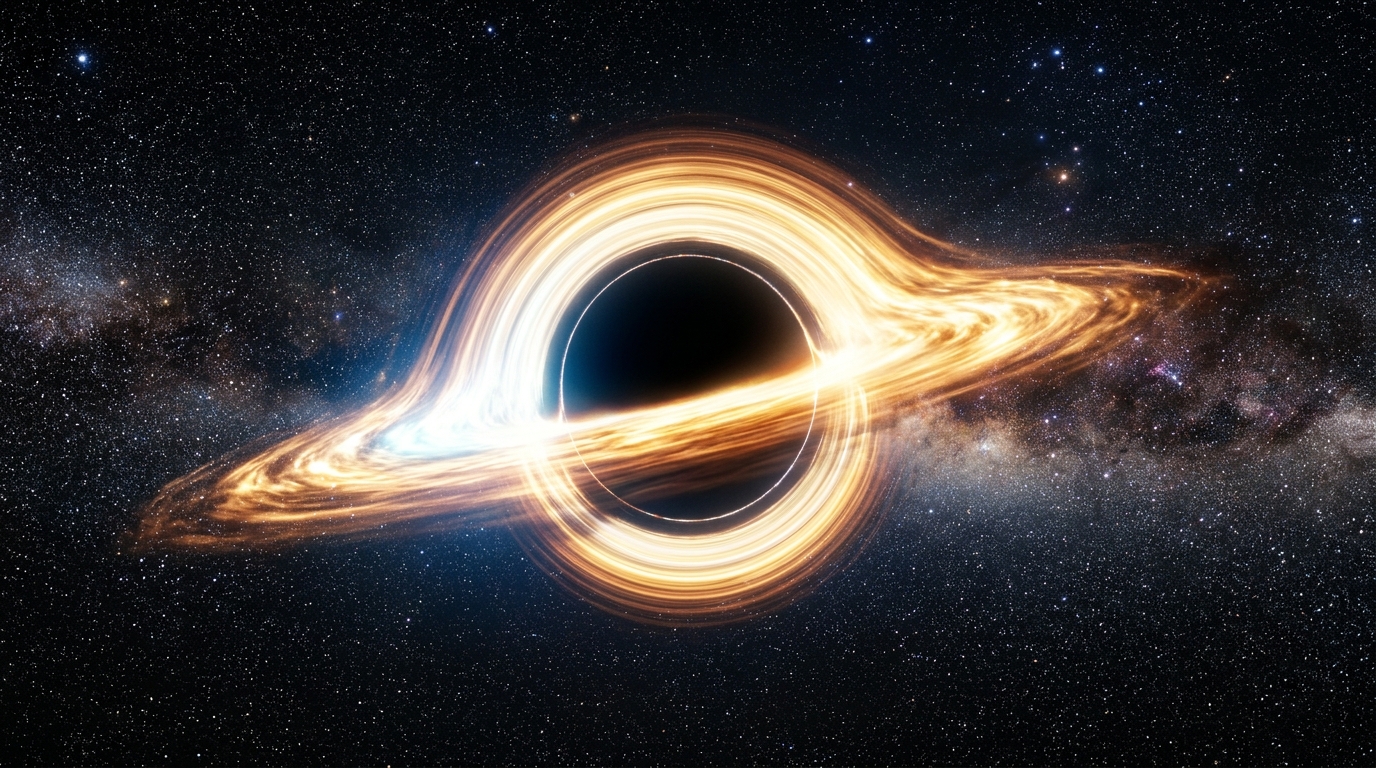
The glowing golden visualization of Gargantua was not the whim of a CGI concept artist. Thorne wrote pages of differential tensor equations simulating how light rays traverse warped spacetime, which Double Negative’s rendering engine translated into raw imagery. It was so mathematically rigorous that it generated two peer-reviewed astrophysics papers:
- Kerr Spinning Black Hole: Gargantua is not a static Schwarzschild singularity. It spins at 99.8% of the speed of light. Thorne calculated this extreme spin intentionally: a static black hole producing Miller’s planet’s extreme time dilation would have shredded the planet apart via tidal forces. Extreme spin flattens the gravitational gradient, allowing a stable orbit right on the edge of the event horizon.
- Gravitational Lensing & The Double Ring: The glowing band arched over the top of the black hole is actually the back of the accretion disk, warped upward over the sphere by Gargantua’s titanic gravitational lens.
- Doppler Beaming: In reality, the side of the disk rotating toward the camera would be blazing bright blue-white, while the receding side would be dimmed red. Nolan slightly softened this asymmetric brightness to prevent cinema audiences from being confused by optical asymmetry.
2. Miller’s Planet: The Brutal Price of Gravitational Time Dilation
The most haunting sequence in cinema remains the landing on Miller’s planet, where one hour on the surface equals seven years back on Earth:
| Reference Frame | Time Elapsed | Physical Mechanism |
|---|---|---|
| Miller’s Surface | 1 Hour | Deep inside Gargantua's intense gravitational potential well |
| Endurance Orbit (Romilly) | 23 Years, 4 Months | Parked outside the steep gravitational trough |
| Earth Horizon | 23+ Years | Cooper's daughter Murph grows from a child into a lead NASA scientist |
3. The Tesseract: Constructing a 5-Dimensional Extrusion
When Cooper plunges past the singularity, he does not meet physical death. Instead, he is intercepted by the Tesseract—a three-dimensional cross-section of a five-dimensional hypercube built inside the "bulk". Thorne and Nolan reasoned that while humans are bound to move unidirectionally forward through time, higher-dimensional beings perceive time as a physical spatial dimension.
In the bulk, Wednesday is not a memory; it is a coordinate on a hallway floor. The Tesseract extracts every second of Murph’s bedroom into an infinite physical lattice, allowing Cooper to transmit quantum gravitational data across the horizon using gravitational waves encoded into the ticks of a watch’s second hand.
4. Who Were "They"? The Ultimate Closed Causal Loop
Throughout the film, characters speculate on the mysterious alien intelligence that placed the wormhole near Saturn. The narrative revelation is profound: "They" aren’t aliens—"They" are future humans. Having solved quantum gravity and mastered higher-dimensional bulk navigation, humanity looked backward into its own historical dawn to create the bootstrap paradox that saved its own species from extinction.
5. What Would an "Interstellar 2" Actually Explore?
While Christopher Nolan is renowned for standalone cinema masterpieces, the narrative universe leaves massive cosmic doors unlocked:
- Plan B Civilization on Edmunds’ Planet: At the film's climax, Dr. Amelia Brand (Anne Hathaway) establishes the colony on Wolf Edmunds’ habitable world, completely isolated from Earth’s remnants.
- Cooper Station vs Colony Evolution: Humanity on the O'Neill cylinder space stations has now mastered gravity manipulation. How would high-tech orbital Earth human civilization clash with Brand’s pioneer gene-bank colony 80 years later?
- Direct Exploration of the Bulk: The ultimate frontier is navigating the 5th dimension directly—stepping out of the spacetime fabric to explore parallel universes or navigate temporal mechanics without a tesseract crutch.
🌌 The Cultural Legacy:
Interstellar proved that blockbuster audiences do not need dumbed-down action tropes. When grounded in emotional truth and genuine scientific awe, the laws of theoretical physics become the most thrilling storytelling canvas ever conceived.